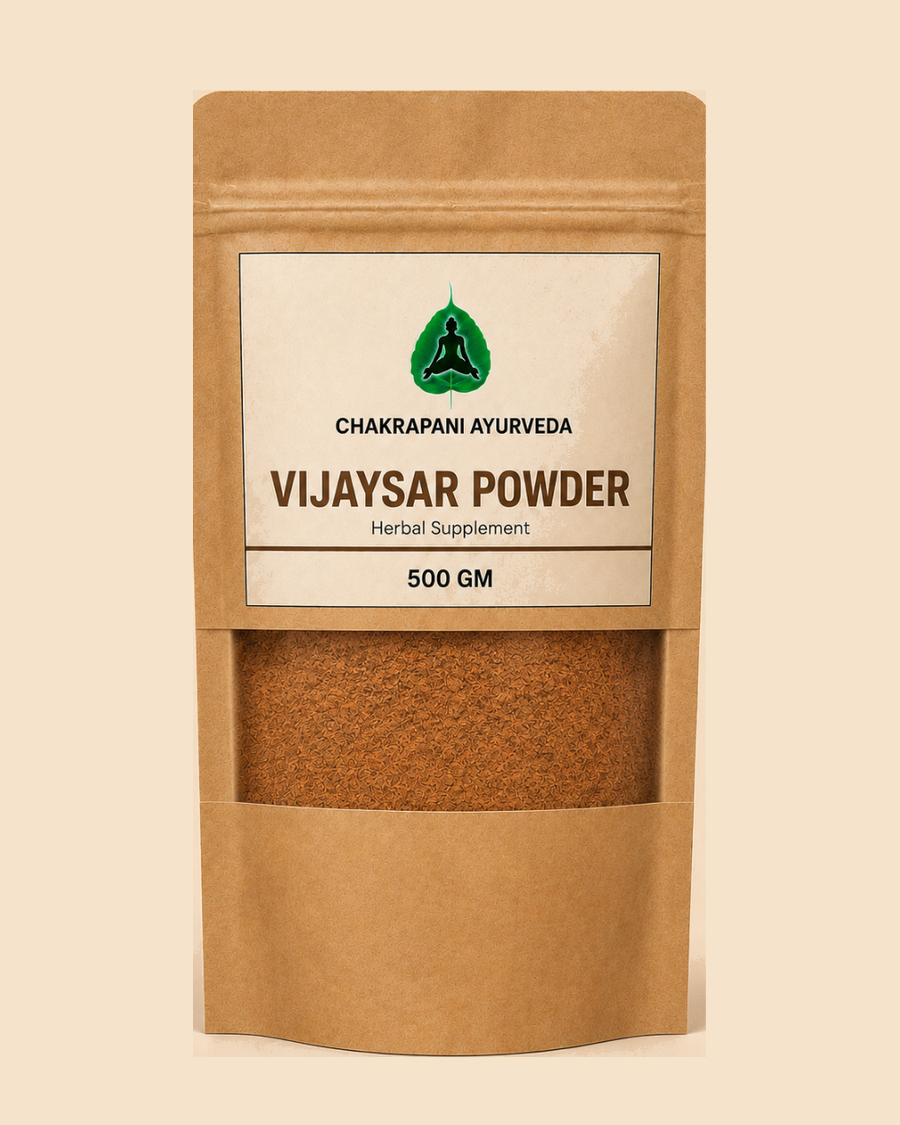
Heartwood powder, 500 g
Vijaysar Powder
Single-herb Pterocarpus marsupium heartwood powder — the form traditionally prepared as a decoction at home.
View ProductPterocarpus marsupium · Indian Kino heartwood
What Vijaysar is, how Ayurveda has traditionally used it, what the published research does and does not show, and how to obtain it from a practising Ayurvedic pharmacy — without exaggerated promises.
Practising since 1995
Chakrapani Ayurveda Clinic & Research Center, Jaipur, India.
Doctor-led guidance
Written and reviewed by qualified Ayurvedic physicians.
A working Ayurvedic pharmacy
Classical formulations dispensed from the clinic's own pharmacy.
Free email consultation
Ask before you buy — there is no charge to write in.
Ayurveda Pharmacy
Prepared and dispensed by Chakrapani Ayurveda. Orders, pricing and shipping are handled on chakrapaniayurveda.com.
Heartwood powder, 500 g
Single-herb Pterocarpus marsupium heartwood powder — the form traditionally prepared as a decoction at home.
View Product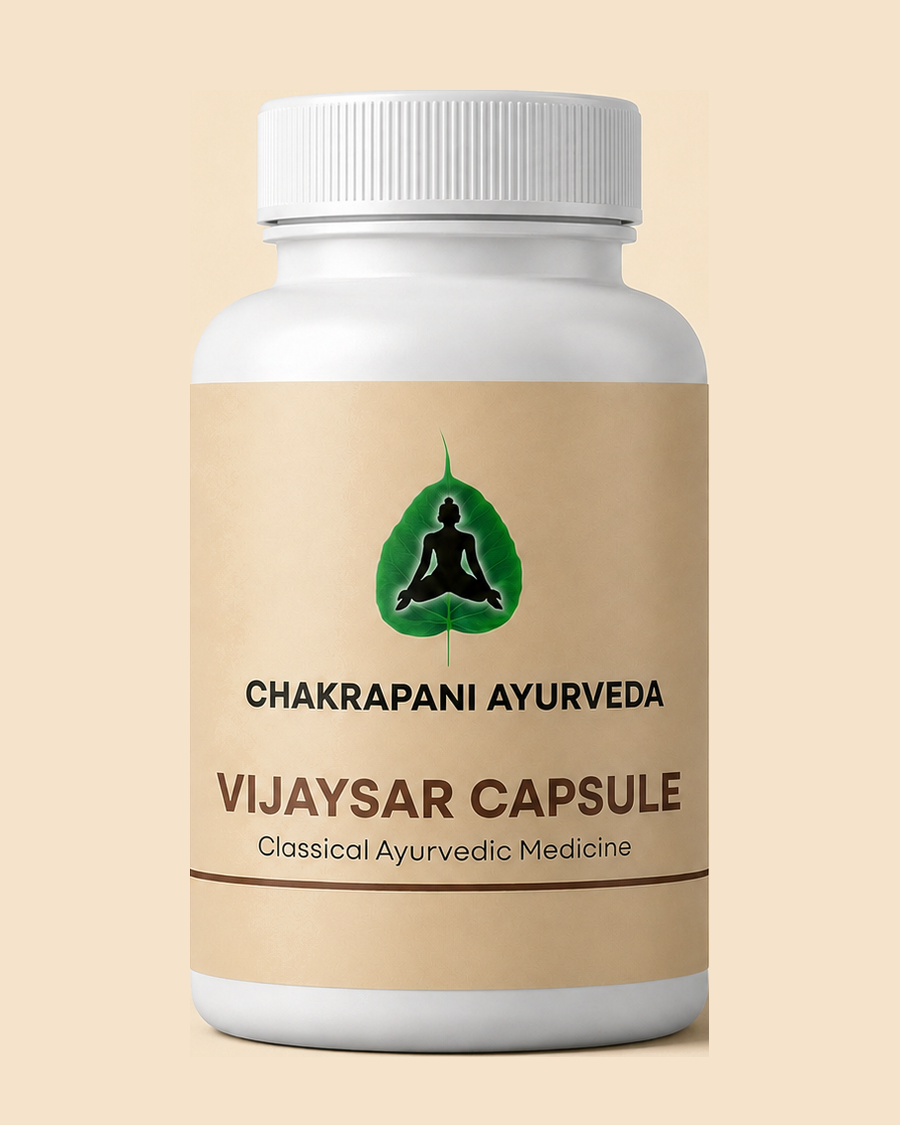
Heartwood in capsule form
The same heartwood in pre-measured capsules, for people who prefer convenience over preparing the herb themselves.
View ProductA wooden Vijaysar tumbler is also made, but it does not currently have its own product page. Please confirm availability with Chakrapani directly — the guide further down this page explains how a tumbler is used.
Go straight to the Chakrapani shop and order the heartwood or capsules.
Shop VijaysarWrite to a Vaidya about your situation before deciding whether the herb suits you.
Ask a VaidyaSee what the published studies report — and what they do not establish.
Read the researchWhat is Vijaysar?
Common names: Bijasar (Hindi) · Indian Kino / Malabar Kino Tree (English) · Asana, Bijaka (Sanskrit)
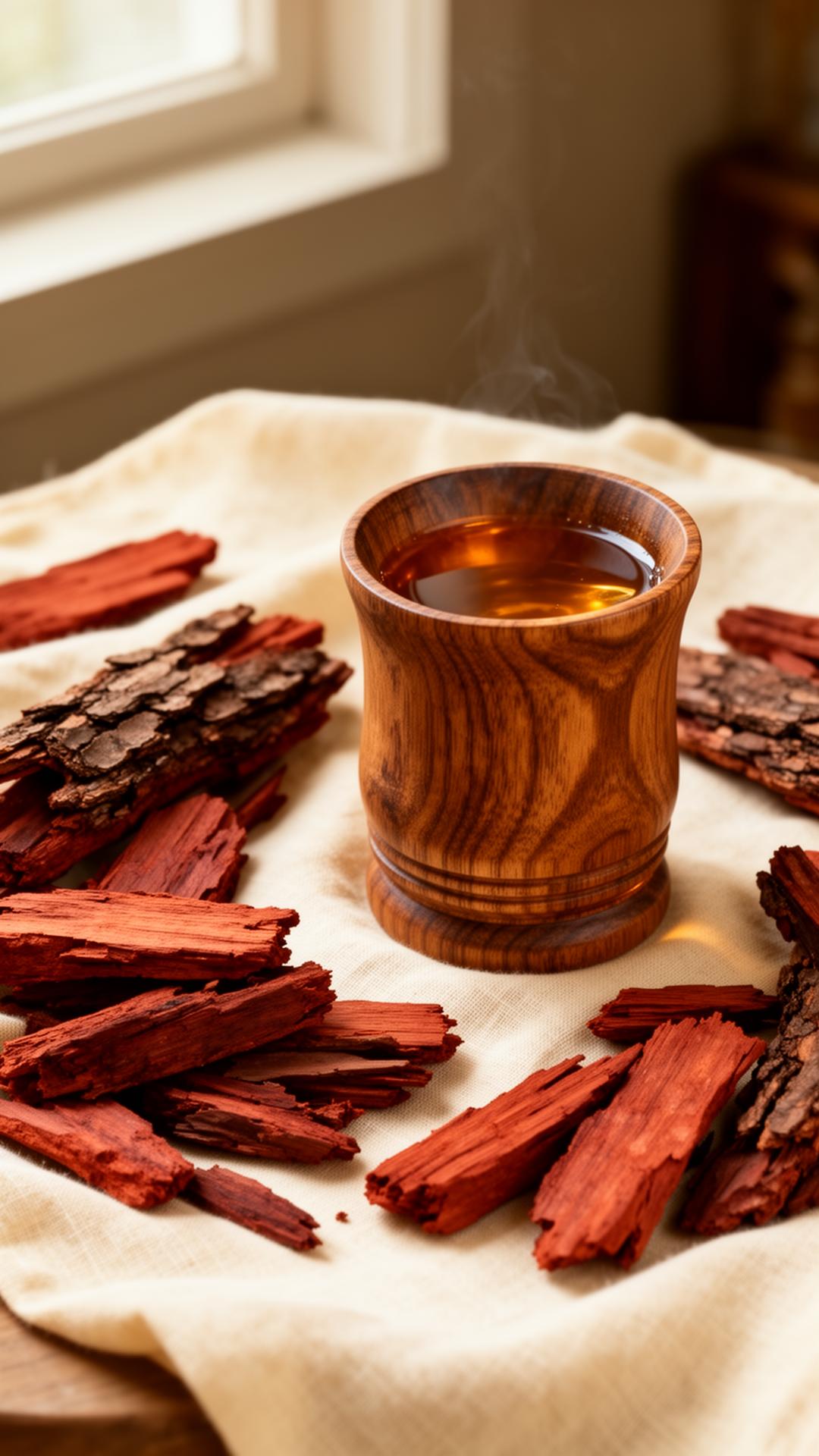
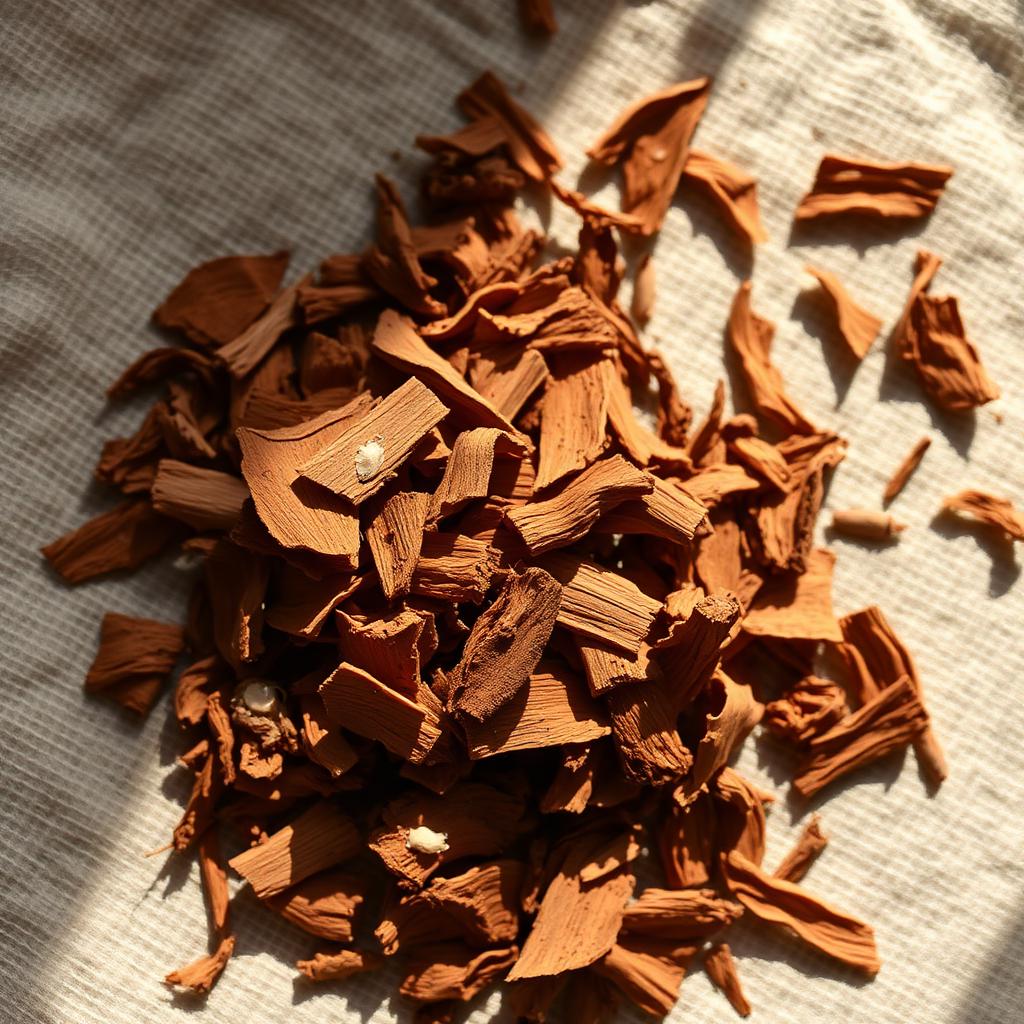
Vijaysar is the deep red heartwood of a tree of the Fabaceae family native to India. Sanskrit sources name it Asana and Bijaka. The heartwood is what gives water standing in a Vijaysar vessel its characteristic amber tint, and it is the part most often used in the preparations described on this page.
Traditional areas of use
Classical texts group Vijaysar with the Pramehahara herbs, used within formulations for disturbed metabolism.
Described as Lekhana — used traditionally where excess Kapha and Meda dhatu are considered to have accumulated.
Kushtaghna in the classical sense — included in traditional preparations for persistent skin complaints.
Used over extended periods in classical practice, always as part of practitioner-guided care rather than self-treatment.
These are descriptions of traditional Ayurvedic use recorded in the classical literature. They are not claims about how the herb will act in any particular person.
The traditional Ayurvedic perspective
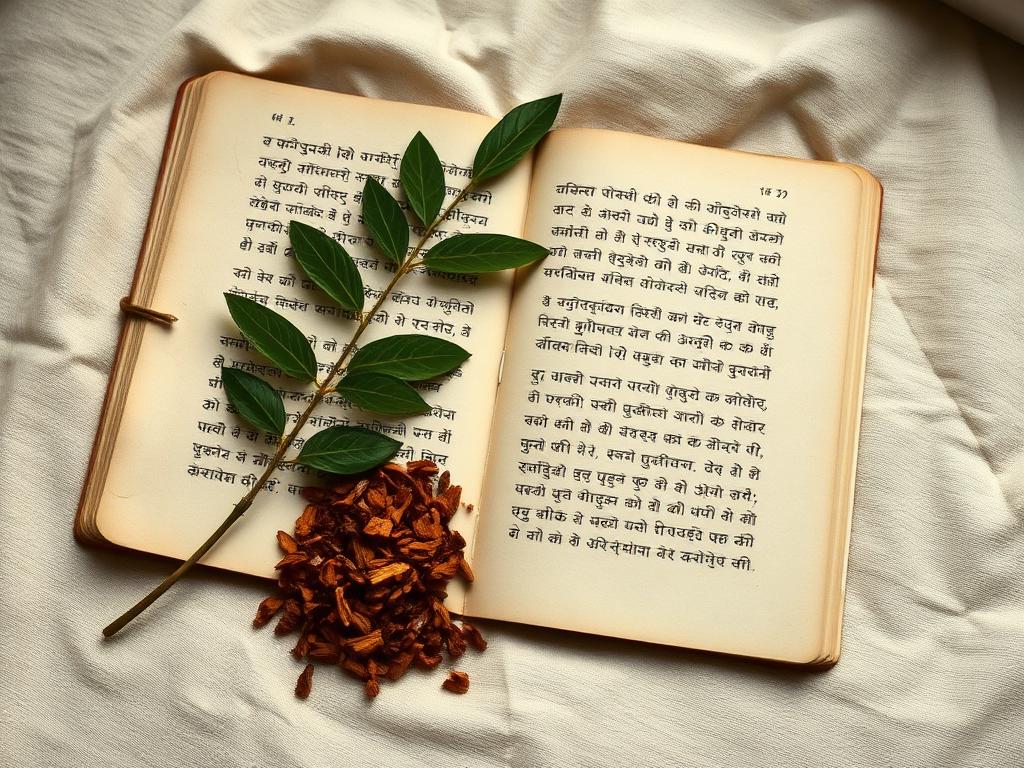
Vijaysar appears in the classical Ayurvedic literature — including the Charaka Samhita, Sushruta Samhita, Bhavaprakasha and Ashtanga Hridaya — both singly and within compound formulations. What follows summarises that traditional framework in its own terms.
Vijaysar is listed among the herbs used in Prameha (a classical group of urinary and metabolic disorders) and Madhumeha, generally within compound formulations rather than alone.
Described as Lekhana and Kapha-Medohara, and used traditionally in Sthaulya where excess Meda dhatu and ama are considered involved.
Classified as Kushtaghna and Krimighna, and included in traditional preparations for persistent skin complaints and slow-healing wounds.
Used over longer periods within Rasayana regimens in classical practice, alongside diet and daily routine rather than on its own.
Selected published research on Vijaysar
Below is a small, deliberately conservative selection of published work involving Vijaysar (Pterocarpus marsupium) or compounds obtained from it. Each entry links to its original publication record so you can read the source yourself. The study designs differ — some human studies used Vijaysar on its own, others used it as add-on therapy or alongside other groups — and much of the remaining research is in laboratories or animals, so none of it should be read as a promise of a result for any individual.
You can also search Indian government-collated Ayurveda research on the AYUSH Research Portal (advanced search). Listing on a research portal is not an endorsement of any product.
Human study — multicentre flexible-dose open trial, Vijayasar alone
Indian Journal of Medical Research (ICMR multicentre trial) · 1998
Human study — open, non-randomised add-on therapy
International Journal of Basic & Clinical Pharmacology · 2015
Human study — multi-arm, with a distinct Vijaysar arm
International Journal of Basic & Clinical Pharmacology · 2017
Animal study
Journal of Natural Products · 1997
Animal study
Diabetes, Obesity & Metabolism · 2005
Laboratory study
Journal of Traditional and Complementary Medicine · 2017
Multi-herb formulation study
Diabetology & Metabolic Syndrome · 2021
Multi-herb formulation study
Journal of Ayurveda and Integrative Medicine · 2019
Laboratory study
ACS Omega · 2022
Animal study
3 Biotech · 2018
Laboratory study
BMC Complementary and Alternative Medicine · 2012
Laboratory study
BMC Complementary and Alternative Medicine · 2015
Laboratory study
Pharmaceutical Biology · 2014
Review of published studies
Drug Design, Development and Therapy · 2023
The research above concerns the plant and its constituents as studied by independent researchers. It is separate from, and says nothing about, any particular product. Chakrapani Ayurveda's own preparation standards, sourcing and testing are described on its website, and questions about a specific batch or product are best answered directly by the pharmacy.
Ask Chakrapani about a productUsing the Herb
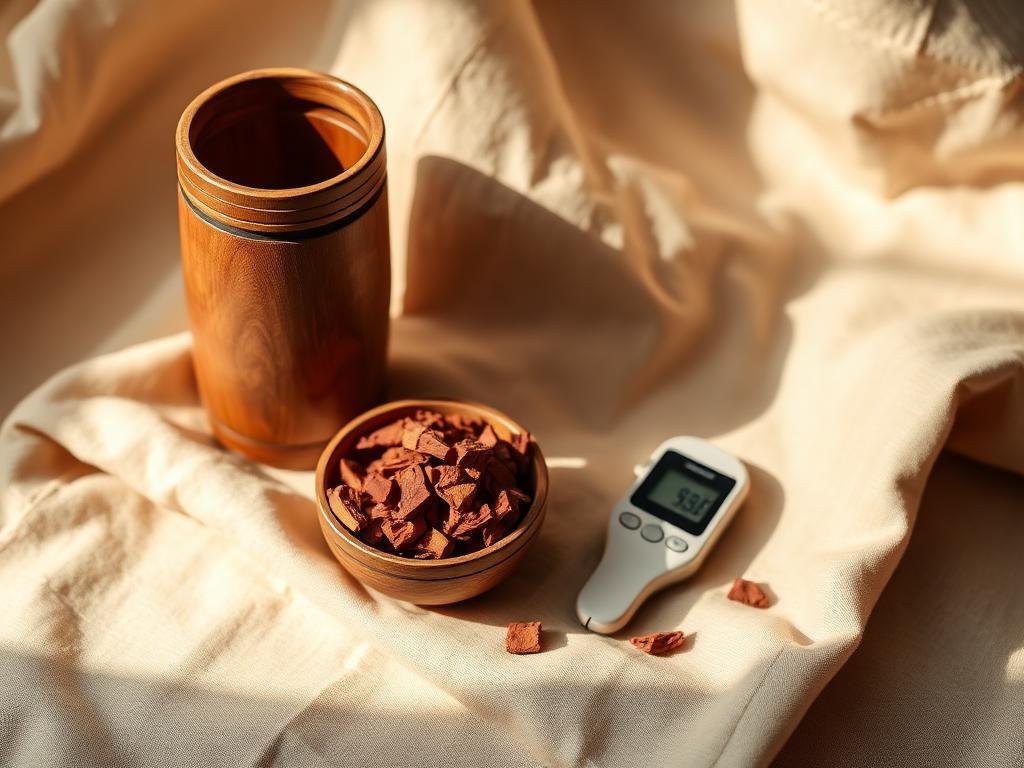
The wooden tumbler is the household preparation most people associate with Vijaysar: water is left standing in a vessel turned from the heartwood, and takes on colour from the wood. It is a traditional practice, not a measured medicine.
Quantities, timing and how often to use a tumbler vary between makers and between individuals. Follow the instructions supplied with the actual product you receive, and ask a Vaidya if you would like guidance specific to you. This page does not set a universal amount or schedule.
Water standing in the tumbler usually takes on a pale to deep amber tint. The depth of colour differs from vessel to vessel and from day to day. A lighter colour is not by itself a sign of a poor product.
The part and age of the wood, how the vessel was turned and finished, how long water has been standing in it, water temperature and mineral content, and how many times the vessel has already been used all change how much colour appears.
Rinse with plain water, avoid soap and detergents, and let the vessel dry fully in air away from direct heat before storing. Do not put a wooden vessel in a dishwasher or microwave.
A wooden vessel is a consumable and does not last indefinitely, but there is no single lifespan that applies to every tumbler. Replace it when the maker's instructions advise, or if it cracks, develops an odour, or shows any sign of mould or damage.
Vijaysar wood products vary widely in the market. Buy from a source that will tell you what the vessel is made from, and confirm details of any order directly with the seller before paying. Chakrapani Ayurveda's team can confirm what is currently available and how it is supplied.Check availability with Chakrapani
Which form suits you — and whether the herb suits you at all — is a question for a practitioner who knows your history and any medicines you take.
From heartwood to finished formulation
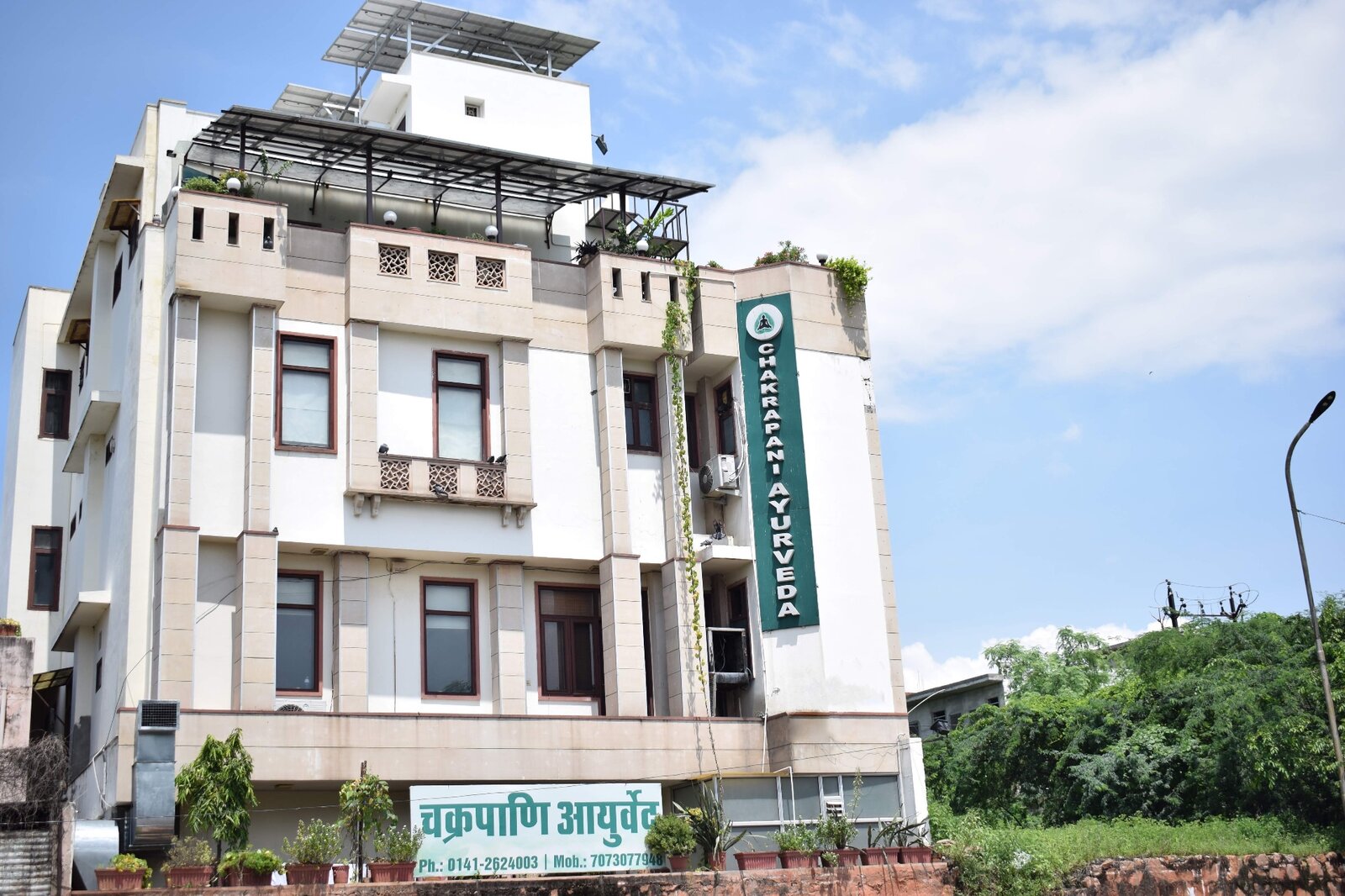
Chakrapani Ayurveda Clinic & Research Center in Jaipur is a working Ayurvedic clinic with its own traditional pharmacy and an international training programme. The Vijaysar products described on this page are prepared and dispensed there.
Vijaysar is supplied as heartwood. Knowing the plant part and its source is the first question to ask of any supplier.
The heartwood is cleaned and processed into pieces or powder, or filled into capsules for measured convenience.
Chakrapani prepares and dispenses from its own pharmacy in Jaipur, so questions about a product can be answered by the people who make it.
Explore Chakrapani
Vijaysar is one herb within a much larger tradition. If you would like to go further, these are the places to start.
Chakrapani's residential, doctor-led classical cleansing and rejuvenation programmes.
VisitCourses and training programmes for students and practitioners, run from Jaipur.
VisitArticles and newsletters written by the clinic's practitioners.
VisitThe wider range of classical formulations and single herbs.
VisitFree Email Consultation
Tell us a little about why you are considering Vijaysar. A qualified Ayurvedic physician at Chakrapani will read your note and reply by email or WhatsApp, whichever you prefer. There is no charge, and no obligation to buy anything.
Start a free consultationAn honest answer, including when the answer is no.
Guidance suited to your situation rather than a standard dose.
How to use it without disturbing medicines you already take.
Frequently Asked
Vijaysar is the heartwood of Pterocarpus marsupium, a tree native to India also known as the Indian Kino or Malabar Kino tree. In Ayurveda it is described as astringent and bitter in taste, cooling in potency, and is used in the classical texts within formulations for metabolic and skin conditions.
Traditionally the heartwood is used as a decoction (kwatha), as a powder, and as water left standing in a vessel turned from the wood. Chakrapani Ayurveda supplies the herb as heartwood pieces, powder and capsules. Which form suits a person is decided case by case by a practitioner.
Published research on Vijaysar remains limited. It includes a small number of direct human studies, alongside animal, laboratory and multi-herb formulation research. None of these studies guarantees a particular change in blood sugar for an individual.
Only with your treating doctor's knowledge. Do not stop, reduce or change any prescribed medicine because you have started an Ayurvedic herb. Tell both your doctor and the Vaidya what you are already taking so that interactions and monitoring can be considered.
There is no single dose that suits everyone. The appropriate form and amount depend on your age, digestion, other conditions and current medication. Follow the instructions supplied with the product you receive, and ask a qualified practitioner for guidance specific to you.
There is no reliable timeframe we can quote, and we will not invent one. Individual responses differ, and any change also depends on diet, activity, sleep and existing treatment. Judge your progress with your doctor using your own monitoring rather than an expected schedule.
It is not intended for self-treatment. Please seek advice from a qualified practitioner before use if you are pregnant or breastfeeding, giving it to a child, living with kidney or liver disease, or taking prescription medicines. Stop use and seek advice if you notice any adverse reaction.
Colour depends on the wood itself, how the vessel was made and finished, how long the water has been standing, water temperature and mineral content, and how many times the vessel has been used. A lighter colour is not by itself a sign of a poor product.